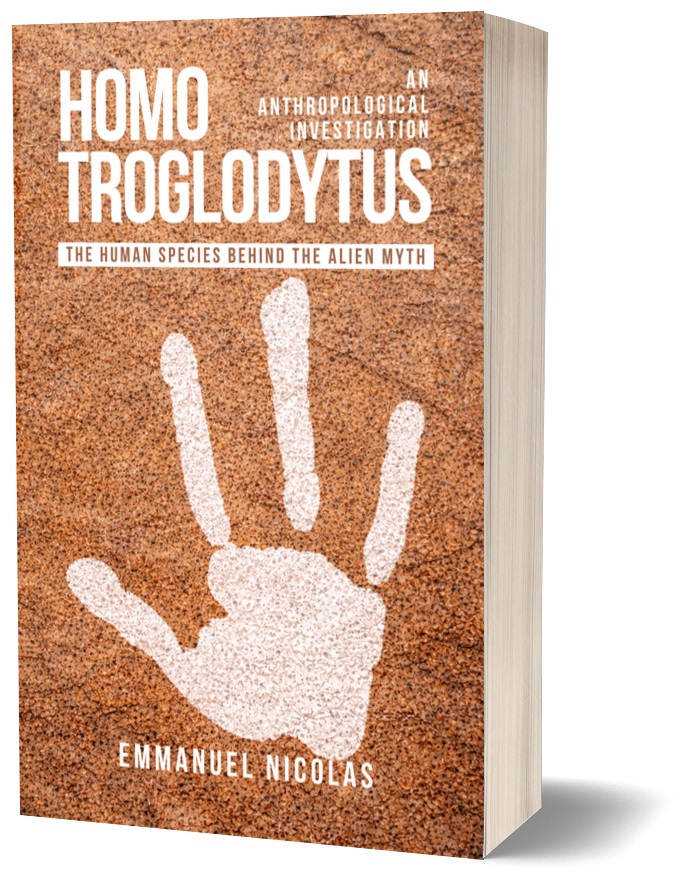
Evolutionary biology reveals a consistent law: when a species adapts permanently to life underground, its body transforms. Across the globe, troglodytic animals display remarkably convergent traits: loss of pigmentation, elongated limbs, reduced musculature, cranial hypertrophy, metabolic slowing. These are not random mutations, but the predictable biological signature of adaptation to darkness.
HOMO TROGLODYTUS investigates a provocative hypothesis: what if a prehistoric human lineage had been forced to continue its evolution beneath the Earth’s surface, isolated for thousands of years, long enough to develop troglomorphic adaptations comparable to those observed in other cave-dwelling species?
Drawing exclusively on established research in evolutionary biology, anthropology, geology, and physiology, this book methodically reconstructs the morphological profile such a human branch would acquire under subterranean constraints: darkness, thermal stability, mineral exposure, spatial confinement, and resource scarcity.
As this reconstruction unfolds, an unsettling convergence appears. The predicted anatomy derived from biological law corresponds strikingly to a figure already embedded in the modern collective imagination.
What if the familiar silhouette associated with extraterrestrial beings is not extraterrestrial at all? What if it reflects exactly what evolution would produce in a humanity that adapted to life underground?
Could Homo troglodytus still exist today?
Table of contents
Chapter I – The cross of Goa
Chapter II – Troglomorphism
Chapter III – Troglodytic Habitat
Chapter IV – Homo Troglodytus
Chapter V – Origin
Chapter VI – The expeditions